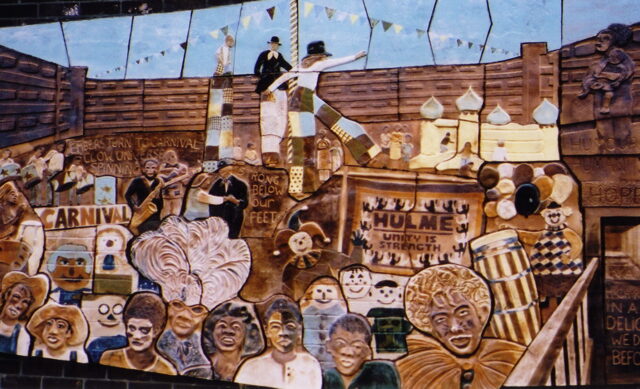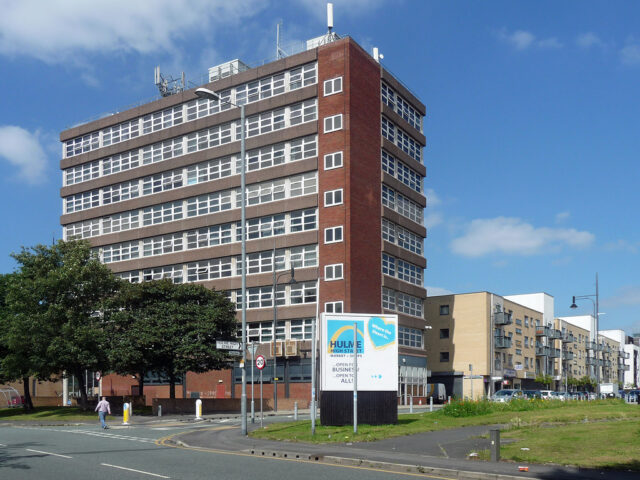
The history and significance of Hulme High Street are linked to the former Moss Side District Centre Shopping Precinct. It was developed as part of a major urban redevelopment programme – the demolition and regeneration of homes and shopping areas in Moss Side, Hulme, and Whalley – that began in the late 1960s. The precinct opened in April 1975 and was intended to become the commercial and civic heart of Moss Side, Hulme, and Whalley Range. It was designed to serve more than 60,000 residents and included shops, a bank, a post office, an indoor market, offices, a performance space, a library, an adult education centre, recreation facilities, swimming pools, and squash courts.
For many local people, Hulme High Street was more than a shopping centre. During the 1970s and 1980s, it became an important community meeting place where residents shopped, met friends and neighbours, shared news, accessed services and built support networks. Its role was especially significant in an area experiencing social and demographic change, including the growth of Manchester’s African and Caribbean communities. Members of the Windrush generation and their descendants were among the local residents who used the precinct’s shops, services and public spaces as part of everyday life.
Moss Side had a substantial Caribbean community and the precinct was a key centre for shopping and community interaction. Specific Caribbean-owned businesses were mainly located in the indoor market but within the heart of the centre, there was a record shop, bakery, and travel centre. Also, there was a business start-up organisation – the Agency for Economic Development – managed by Caribbean people and a Northern Black Business Association. Other Caribbean-led organisations included a nursery, an office skills training project, and an ITEC centre.
The precinct declined due to social and environmental challenges, changing shopping habits and wider regeneration plans. It was demolished between 1993 and 1994. Today, although the buildings have disappeared, Hulme High Street remains important in local memory as a symbol of post-war planning, community life and the changing urban history of Moss Side and Hulme.