The 25-metre Hulme Mural celebrates 2,000 years of local history, from Roman times to the end of the 20th century. Pottery students based at Hulme Adult Education Centre used two tonnes of clay and spent two and a half years making it for the Millennium. The mural covers the wall of the former education centre, built in the 1960s on the site of the old Hulme Town Hall. Johnny Vegas, who trained as a ceramicist before becoming a comedian, unveiled it in 2002.
Artefact
Hulme Mural
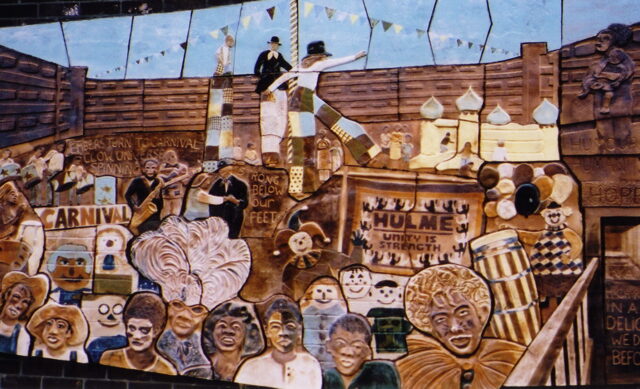
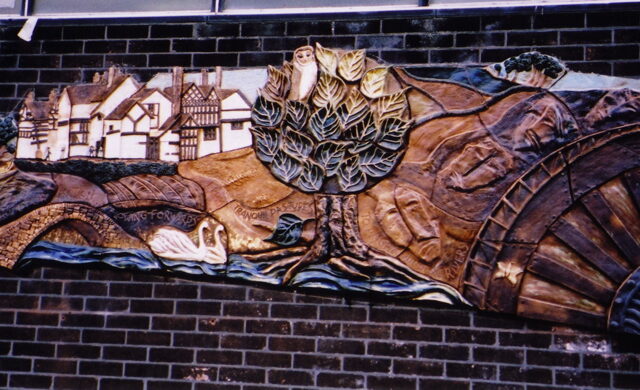
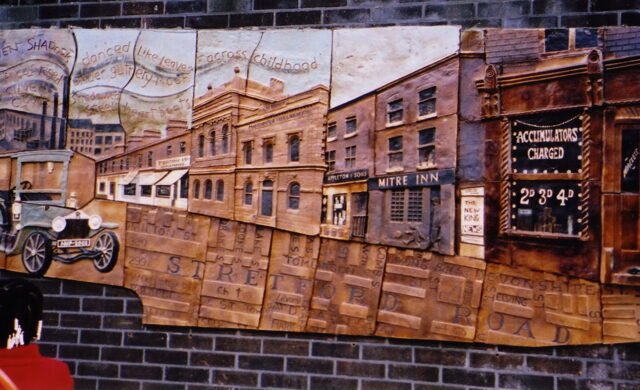
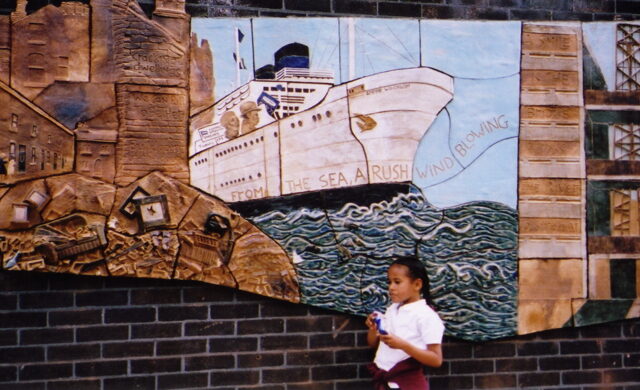
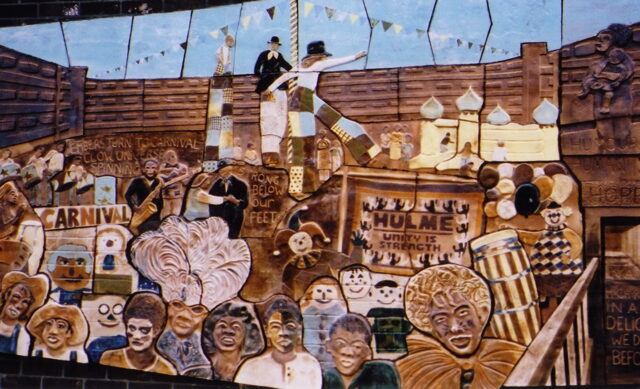
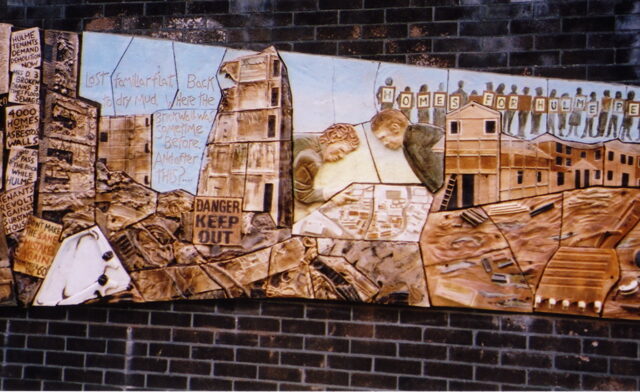
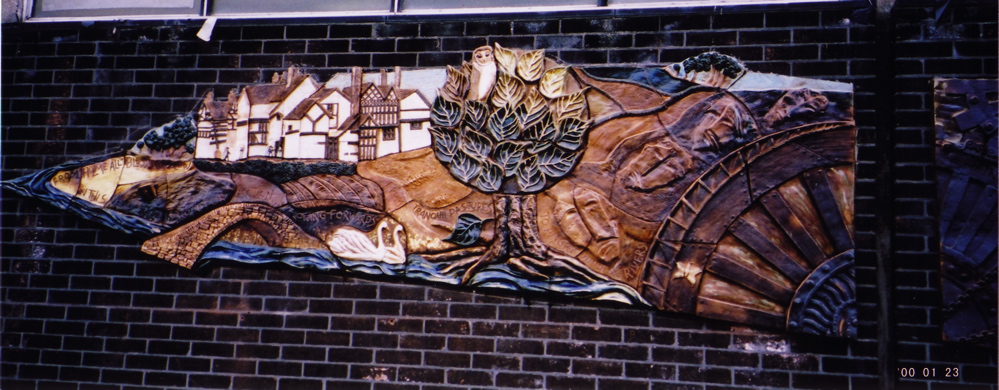
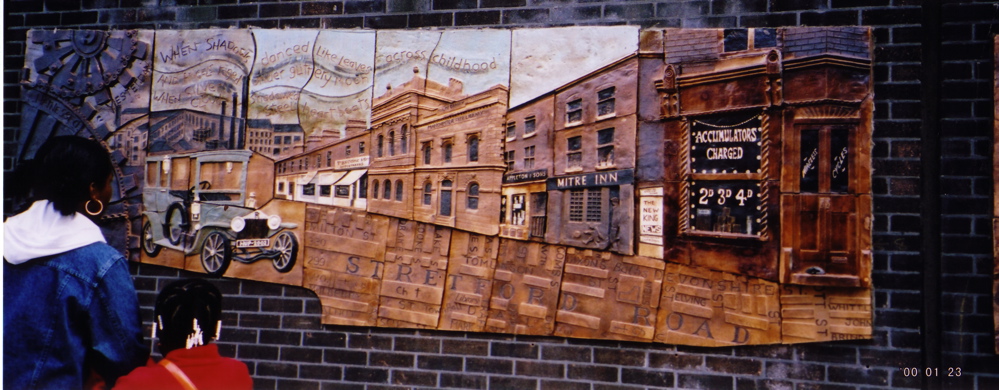
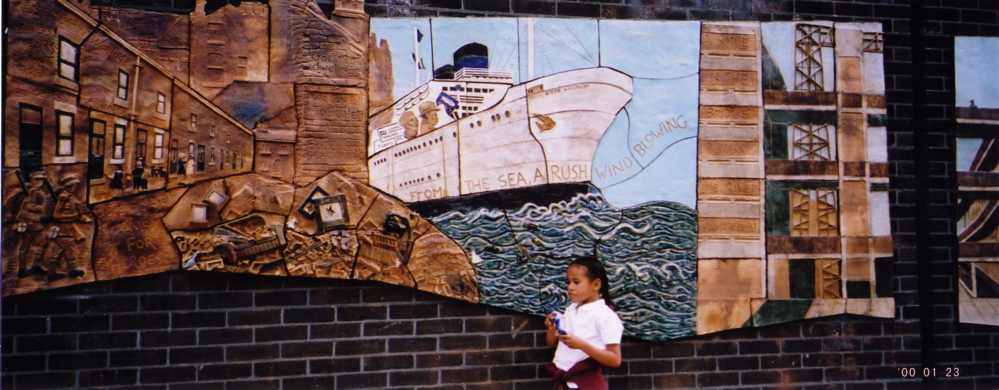
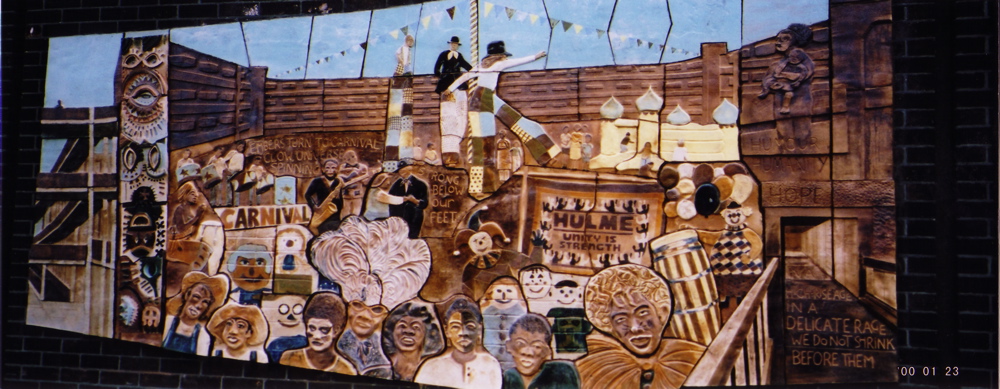
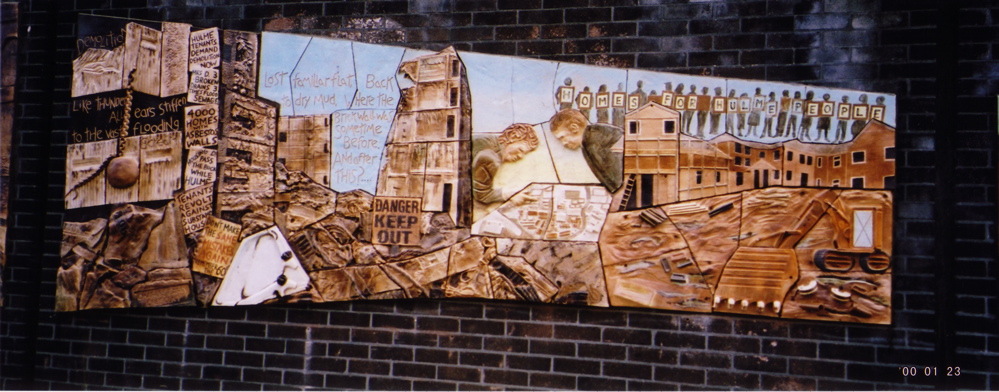
The Hulme Urban Potters were an independent community group made up of local students at the Adult Education Centre. Their tutor, ceramic artist Brigitte Soltau, coordinated the project but described it as a genuine group effort. Songwriter and activist Claire Mooney wrote a poem that was carved into the mural, and sculptor Jim Robison advised the team. The students were Christine Barber, Joanne Duckett, Barbara Dussie, Cal Harvey, Agata Ileka, Anna Martin, David McLean, Darryll Olbinson, Stan Olsen, Wendy Porter, Delores Ragou, Alan Smith, Angela Stewart, Adam Trent, Beverley Watson, Tina Webster and Lynda Wilson.
Design work began in 1999, when the Millennium felt like a major turning point. Newspapers warned that computers might fail as the date changed to 2000, while Hulme was already living through decades of upheaval. The Hulme Crescents had been demolished and new developments were replacing the old flats. Surrounded by change, the Potters wanted to make something lasting that showed the community’s deep roots, even as its buildings and streets repeatedly changed.
Rather than create a simple timeline, the group chose the periods when Hulme’s physical appearance changed most dramatically. They researched in Hulme Library, next to their pottery workshop, spending weeks with photographs, newspapers and old documents. Personal collections and earlier community projects added more material. The mural’s flowing outline was inspired by the shape of Hulme’s boundaries and divided into six large panels for the long wall.
The panels show Hulme as farmland, with timber-framed houses, wildlife and water power. They move through the industrial growth of the 1840s, when factories and shops spread across busy streets, and the bomb damage of the Second World War. The rebuilding that followed brought Caribbean newcomers whose carnivals, music and dancing added new life to the area. Later panels show the Hulme Crescents, designed in the 1960s to improve housing but damaged by serious faults that contributed to deaths and another round of demolition. The story ends with Hulme Homes for Change, a cooperative that tried to protect community life during further redevelopment.
After an open day showed the plans to local people, the Potters faced the difficult job of turning drawings into a huge ceramic artwork. Projectors enlarged small images onto full-size paper patterns. The team tested several clays before choosing the wonderfully named “earthstone crank”, which stayed smooth and flat when fired. They sliced blocks with wire, rolled them under a long wooden cylinder and joined the slabs. Waterproof “builders paper” stopped the clay drying while they cut, carved and modelled the surface.
Glazes and natural oxides added colour before the pieces were fired in kilns at Manchester Metropolitan University. The team then assembled the mural on the wall like a giant three-dimensional jigsaw. After more than two years of research, problem-solving and practical work, it was unveiled on a sunny Monday in September 2002 by the artists, their supporters and Johnny Vegas.
The Hulme Mural shows what a community can create together, but the process was far from easy. Brigitte called it a “really steep learning curve” and said that, had everyone understood the difficulties at the beginning, they might not have continued. The mural’s size, constant fundraising, different working patterns and the need to combine many ideas all caused problems. Working on one project every week for two years also demanded real patience. Those who stayed with it nevertheless said they learned a great deal and enjoyed the experience. The difficulties became part of the shared achievement celebrated by the finished work.
– Johnny Vegas unveils the finished mural“It’s lovely to be able spend two years in bed and not lend a finger and be able to be part of the magic. That’s the joy I get from today. Sharing in that sense of achievement, knowing you’ve done naff all.”
– a Hulme Urban Potter recalls the mural’s creation“We were creating a giant 3-D clay jigsaw. We had to learn how to scale up our artwork, roll enormous slabs of clay, carve and hollow each piece, decorate and finally fire. The Hulme Centre pottery turned into a factory, with giant shelving made of pallets lining the corridors.”
– Brigitte Soltau, ceramics tutor and project coordinator“The idea came from a deep personal attachment we all shared to the community where we lived and worked. We were united in a wish to acknowledge the dramatic physical changes to the area, and the resilience of the people of Hulme during the centuries that had passed.”
– Cal Harvey, Hulme Urban Potters“It’s not just that you learn the skills of pottery, but you’re also learning about the history of Hulme. It’s really exciting to go all the way back to Roman times and then follow it through right up to the present day. And we’re making history by making the mural. It’s great to know that it’s always going to be there and I’ve contributed to it.”
You can read more about the Hulme Mural and its significance on two great Manchester history blogs, Our Manchester and Manchester’s Radical History. If you’re interested in the history of Hulme, have a look at this interactive map which shows where parts of Hulme were bombed during World War Two.
Do you have a favourite public artwork that was created thanks to a community effort? Get in touch to tell us about it!
Related
Artefact
•Hulme
Hulme High Street
Explore the history of Hulme High Street, a major shopping and community centre that served Moss Side, Hulme and Manchester’s Caribbean communities.
Read more
Artefact

Artefact
•Moss Side
New International Society and Club
Read about the New International Society and Club, founded by Len Johnson and other organisers to bring communities together and challenge racism in post-war Manchester.
Read more
Artefact
Artefact
•Hulme
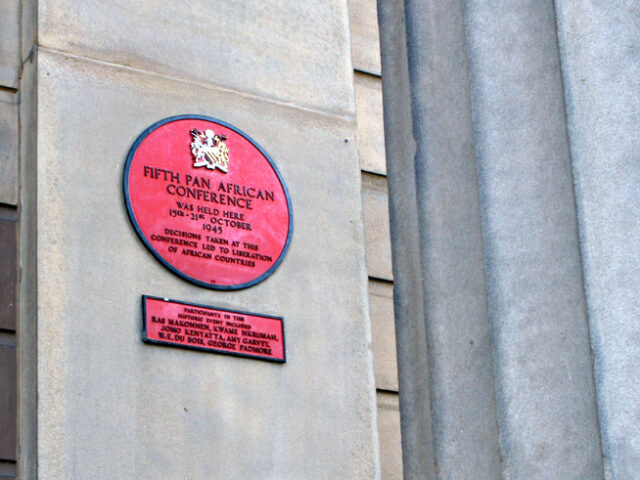
Site of the Fifth Pan-African Congress, held in October 1945
Discover the story of the Fifth Pan-African Congress, a landmark event in Manchester’s Black history that helped advance decolonisation and African independence.
Read more
Artefact