Outside Manchester Piccadilly Station, seven bronze soldiers stand in a line. Victory Over Blindness shows servicemen blinded in combat helping one another leave the battlefield. The sculpture marks both the centenary of Blind Veterans UK, founded in 1915, and 100 years since the end of the First World War.
Artefact
Victory Over Blindness
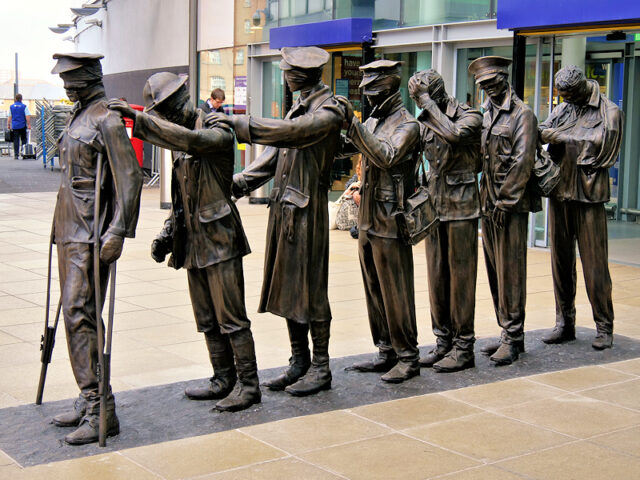
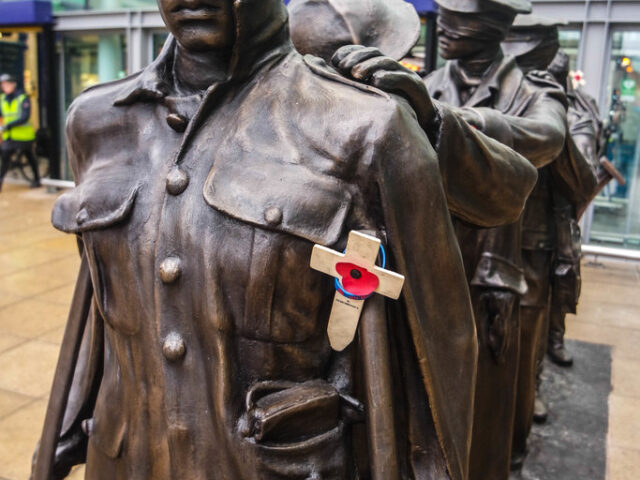
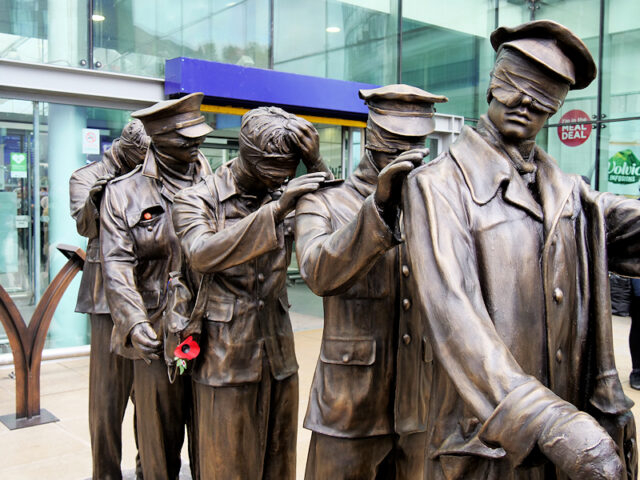
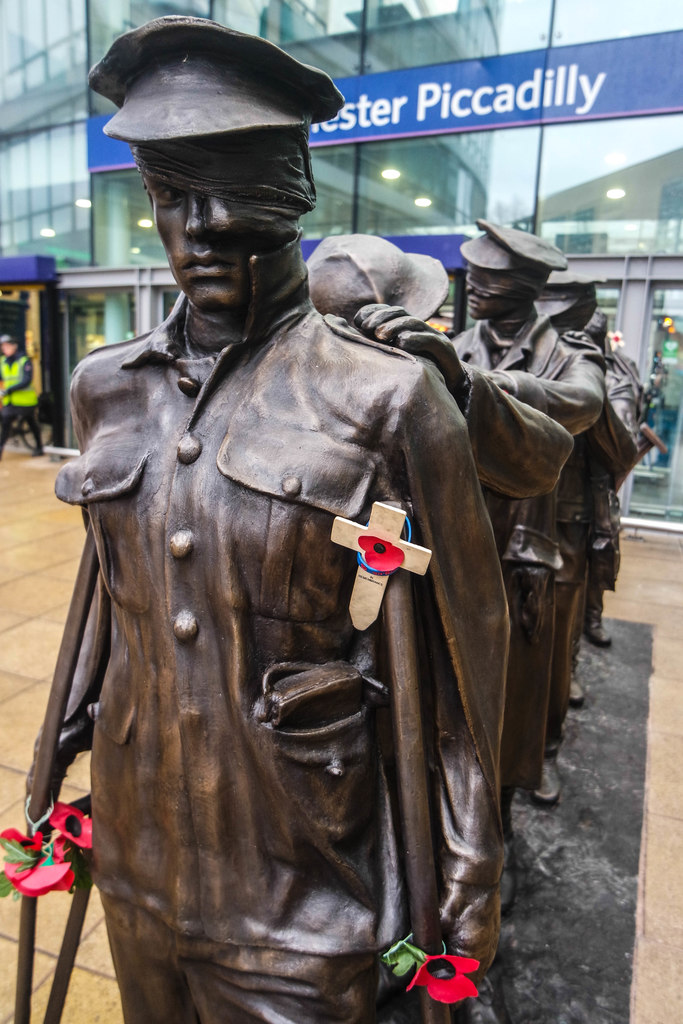
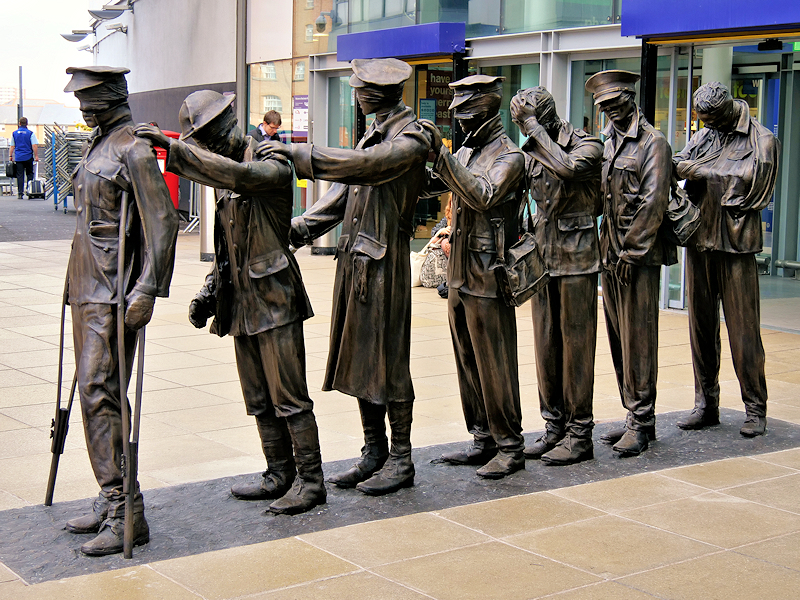
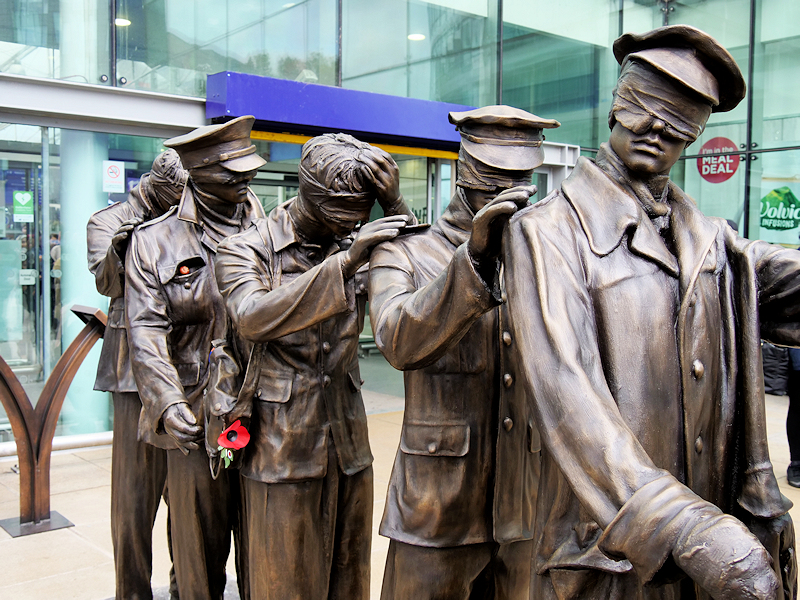
A partially sighted officer on crutches leads the group. Each man touches the shoulder of the soldier in front so that they can move together towards safety. The work is strongly visual but also deliberately tactile. Its creator, Johanna Domke-Guyot, encourages visitors to touch it, and the figures stand at ground level rather than on a plinth so blind and disabled people can reach them.
A plaque in Braille says: “Remembering the returning blind veterans of the First World War. More than 3,000 veterans lost their sight as a result of their service in the First World War. Making their way home from the front, they began their journey to rebuild their lives after sight loss”. Johanna created the sculpture, which the Countess of Wessex unveiled on 16 October 2018.
Johanna is partially sighted because of multiple sclerosis, an autoimmune condition with many difficult symptoms. She studied art as a way to cope with her illness and formed a close relationship with Blind Veterans UK. When the charity commissioned its centenary memorial, she met some of the thousands of veterans it had supported and studied historic photographs. One image of blinded First World War soldiers leading one another away from enemy lines became the main inspiration.
Victory Over Blindness took five years to complete. Johanna was also the full-time carer for her sister, whose brain had been damaged by meningitis, so she often worked at night while her sister slept. She first built the sculpture in concrete and later had the permanent version cast in bronze.
– Johanna Domke-Guyot, sculptress of Victory Over Blindness“The statue won’t be on a plinth but at ground level. That was very important to me because it means that a disabled or blind person can access it. I want people to touch it; I want it to be a people’s artwork.”
– HRH the Countess of Wessex, speaking at the statue’s unveiling ceremony“As we approach the anniversary of the end of the First World War and, quite rightly, remember all of those who never returned, it is also important to remember those who did, changed by their experiences.”
– – Andy Burnham, speaking as Mayor of Manchester“It’s an honour for Greater Manchester to permanently host this sculpture – it’s ultimate message is one of camaraderie, the journey of rehabilitation and ultimately, the ability to overcome adversity”
Read this blog post by the sculpture’s creator Johanna Domke-Guyot, or explore the National Disability Arts Collection and Archive for more art that represents disabled people. Alternatively, visit Blind Veterans UK to find out more about the charity or make a donation.
What’s the story behind your favourite sculpture in Manchester? Keep exploring This Is Us to find out, or get in touch to let us know!
Related
Artefact
•Wythenshawe
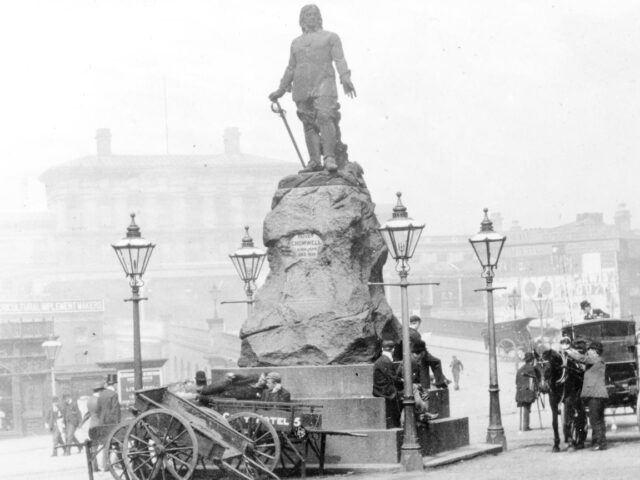
Oliver Cromwell statue
Discover why Manchester chose to honour Oliver Cromwell, a controversial figure remembered for overthrowing the monarchy, invading Ireland and imposing strict Puritan rule.
Read more
Artefact
Artefact
•Piccadilly
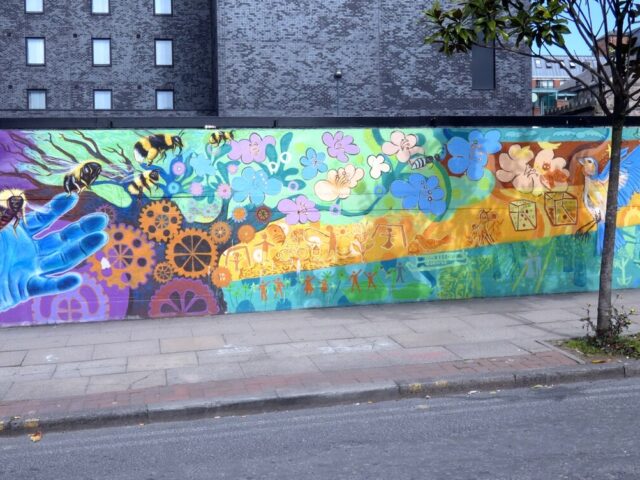
Ducie Street Doodle
Read about the Ducie Street mural created by Mancunians who experienced homelessness through a collaboration with Manchester charity Mustard Tree.
Read more
Artefact
Artefact
•Northern Quarter
Stevenson Square mural site
Discover how Outhouse transformed a public toilet in Stevenson Square into a globally recognised mural space showcasing public art for eleven years.
Read more
Artefact